







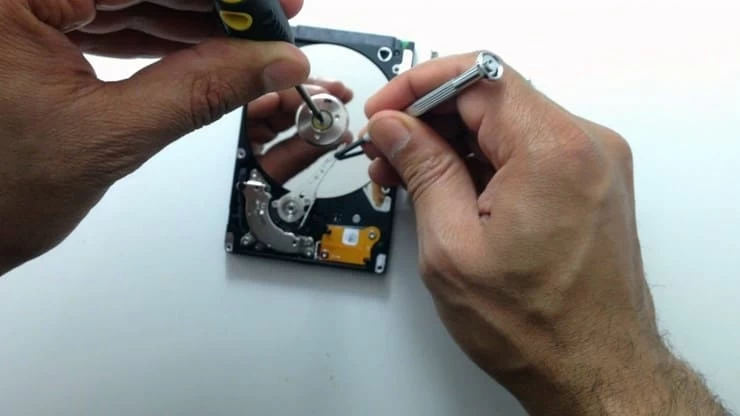
Hard drives are one of the fundamental parts of our computers. Not only are all the files necessary for the machine to work stored there, but we also use them as a space to store our most precious files.
Whether they are work documents, photographs, videos or other files, it is quite likely that they have some type of value, so it is advisable to always have several backup copies (physical and in the cloud) so as not to regret that a misfortune could leave us without them.
But what do we do if a hard drive from which we want to recover certain data has been damaged? How can we know what is happening to him? Can we recover the data we had stored on it? Most of these questions have a solution, so let’s take a closer look at hdd recovery service.
Hard Drive Failures
If you are having problems accessing certain files, if you notice that the computer is not working as it should or that it hangs more than necessary, you may have a problem with your hard drive. At this point, it is necessary to know that disks can break down for two reasons: Due to physical damage or due to so-called logical damage, those in which the operating system is not able to process the stored information because it has been corrupted or damaged.
Physical damage can be related to different situations, from a fall to an electrical overload. So the first thing to know what we are facing is to open the tower of our computer to have the hard drive at hand. If we turn on the computer and see that it does not make any noise or, worse, that the sounds that come out of it are not normal, it is likely that the damage is physical.
It doesn’t hurt to check that the error could be due to a problem with the power supply. In this case, our best option is to connect the drive to another computer to see if it works normally. If it doesn’t, we’ll know it’s broken.
Other situations may also occur such as the heads being damaged or the disk having overheated. In the case of physical damage, once we have confirmed it, the most recommended option to repair it and recover the data is to send it to a technical service where they should provide a solution to both needs.
To know if we are dealing with a disk with logical damage, just take a look at the behavior of our machine. If it gives us problems opening certain files or it ‘hangs’ insistently, it is possible that there are damaged areas of the disk that cannot be accessed. We will also know if the disc makes a sound as if it is sanding the surface. In this case we can use tools to solve the problem.
Repair a Hard Drive
If our hard drive failures are logical in nature, we have several tools at our disposal to carry out maintenance. The main thing is to know what is happening and how we have to act.
We may have reached this point for various reasons, from a virus to having turned off the computer in the middle of an installation or due to copying files that were not carried out satisfactorily.
The first step before starting work is to make a backup copy of the files you still have to avoid further problems. Once done, we can use two tools in Windows to find out what is happening to the disk: error checking (right click on the hard drive you want to check > properties > tools > error checking) or CHKDSK. In reality, both do the same task, only the first is more visual than the second.
We will have to use the latter from the command prompt, this being the path that you must write: CHKDSK C:/f (where we have written C you have to put the letter of the drive you want to analyze). The CHKDSK tool should repair all errors found on the drive we have selected.
If after following these steps you still encounter errors, we recommend two solutions. One is to opt for other hard drive repair software. On the Internet you will find a good handful of them, so you will not have problems choosing.
The second is to perform a low-level format, an operation in which all the information on the hard drive is erased so that if there are physically damaged sectors, they are not formatted again (which would cause us to lose space on the disk) and those will disappear. Logical damages that there may be. A complete start from scratch.
We have said it before but it doesn’t hurt to remember it. Before starting any operation to recover data from a hard drive, it is important that you make a backup copy. Now, having said that, it is important to emphasize that once a file is deleted it is possible to recover it, although you should try to do it as quickly as possible.
When we delete a file, the physical information is still stored on the hard drive. What has happened is that the operating system has told the disk that this space is available, so it will use it as soon as it deems necessary.
To prevent the data from being overwritten, you can use some other trick, such as using another main hard drive and the damaged one as a secondary one to prevent the system from erasing that data.
As with repair tools, you have a wide range of free and paid file recovery programs on the Internet. Keep in mind that in this area you can do tricks to recover files but, to do so, it is often necessary to go to the checkout. And the price will depend on how complicated it is to recover that data.
Final Note: SSD Hard Drives Have A Finite Life
Although a traditional hard drive will not live forever, it is important that you know that SSD hard drives are designed in such a way that, sooner or later, they will pass away. Solid state memory disks, or SSDs, are made up of cells that store data.
Each of these cells is designed to be able to write, delete and overwrite data a limited number of times, so when a certain number is reached, the cells wear out and can no longer be used. This figure is measured by TBW (Terabytes Written or terabytes written, the equivalent of all the information that it can process), it is usually given by the manufacturer, and it is a measurement that is good to take as a reference although you should not think that it is written in stone.
As a final tip: Make backup copies. As many as you can. A physical copy and a couple in the cloud should be more than enough so that your information is not in danger at any time. Although the physical copy may be more cumbersome to make, you have no excuse to instantly synchronize the folders with the most important documents with any cloud service provider to avoid greater evils if the day comes, hopefully in the distant future, when your hard drive dies.


